Among Top Seven Books Recommended Year End by Barron’s Economics Editor
Among Top Five Finance and Economics Books 2009 Recommended by 800-CEO-Read
Featured on Glenn Reynolds’ Instapundit website
“…[An] impassioned…and…much needed book.”
—Gene Epstein (Barron’s)
“Just what the world needs, and just in time. Keynes is demolished and his quack system refuted. But this wonderful book does more. It restores clear thinking and common sense to their rightful places in the economic policy debate. Three cheers for Hunter Lewis!”
—James Grant (Editor of Grant’s Interest Rate Observer)
“Lewis has exposed with unmatched clarity the lineaments of Keynes’s system and enabled us to see exactly its disabling defects. Keynes defied common sense, unable to sustain the brilliant paradoxes that his fertile intellect constantly devised. Lewis’s book is an ideal guide to Keynes’s dangerous and destructive economics. . . .”
—David Gordon (LewRockwell.com)
“Lewis has done a service, even if in the negative, of concisely and critically summarizing Keynes’s economic theories, and his book will make readers think.”
—Library Journal
“A splendid book!”
—Patrick McIlheran (Milwaukee Journal Sentinel)
“[This] compelling, powerful, and extremely readable book…is fantastic….’Must’ reading.”
—Kevin Price (CBS and CNN Radio and BizPlusBlog)
“[This] highly readable…book fills a missing niche in the literature: a debunking of Keynes for the general reader….Lewis is an excellent writer [and] demystifies…a famously difficult author to understand….The work contains so many gems that it would be impossible [to list them all].”
—Robert Blumen (Mises.org)
“Defogs what Keynes said [in] terms that a layman can understand.”
—Cecil Johnson (Widely syndicated McClatchy reviewer)
Summary
John Maynard Keynes died in 1946, but his thinking continues to dominate world economic policy. Bushonomics, Obamanomics, and the policies of the U.S. Federal Reserve have all ultimately been derived from Keynes’s book, The General Theory of Employment, Interest, and Money, usually referred to as Keynes’s General Theory or The General Theory.
What does Keynesian economics tell us about the Crash of 2008? First that crashes are an inevitable part of Capitalism—they reflect what Keynes called the “animal spirits” of private markets. Second that the Crash creates a downward spiral that feeds on itself. If Keynesian remedies are not promptly applied, there may be no economic recovery. These remedies, the essence of Keynesianism, include the U.S. Federal Reserve printing money and lowering interest rates, bailouts, and economic stimulus through deficit spending.
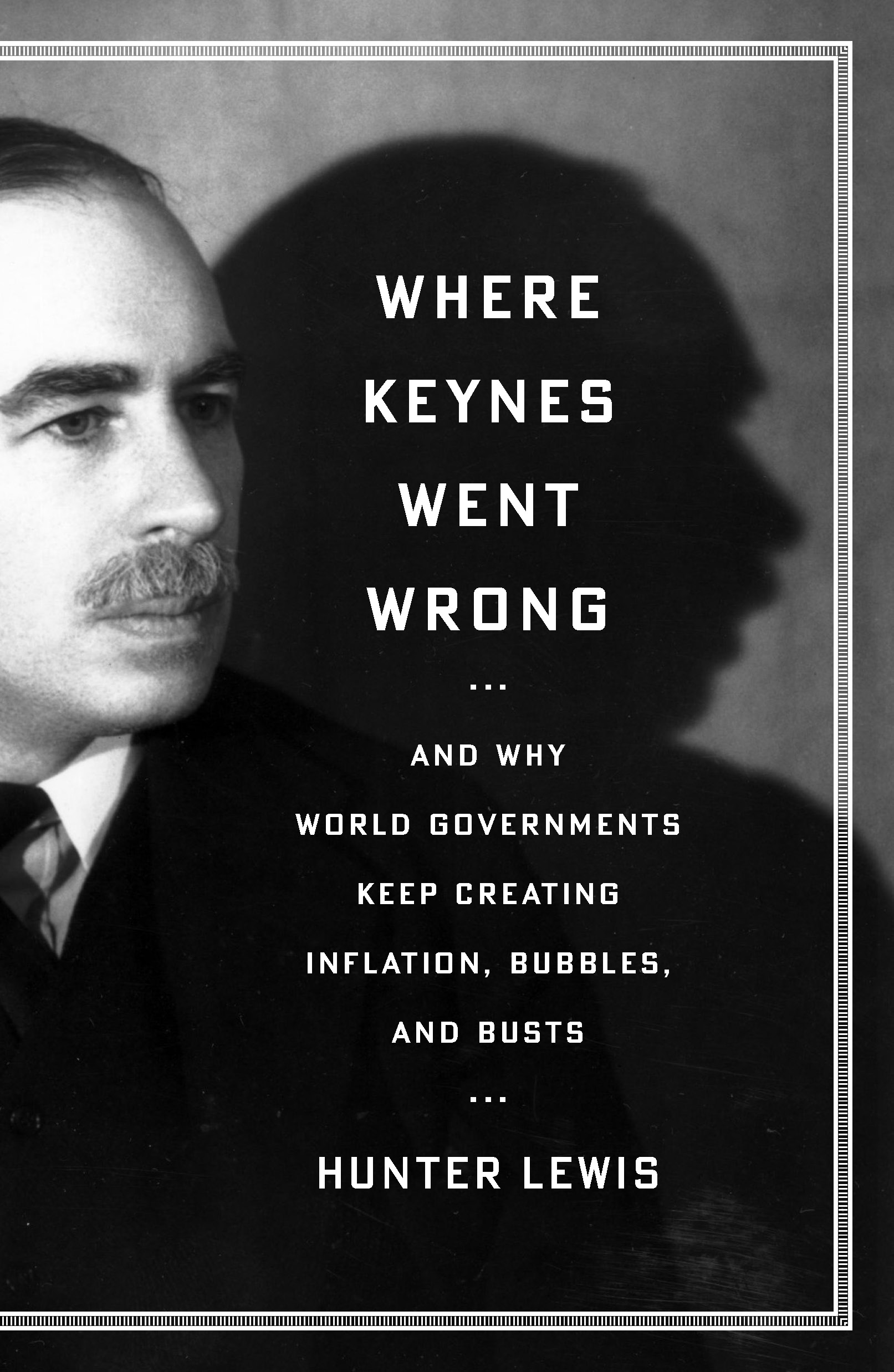
Where Keynes Went Wrong demystifies Keynesian economics. It reveals what John Maynard Keynes really said. And it offers a startling and persuasive argument that Keynesianism is leading us down a path not to genuine economic recovery, but to inflation, bubbles, and crashes.
More about Where Keynes Went Wrong
When the world financial system failed in 2008, world governments intervened decisively. Guided by Keynesian economics teams with impeccable credentials, they intended not only to “stimulate” the economy, but to “jolt” it back to borrowing and spending as usual. All of these actions were taken from a playbook devised by British economist John Maynard Keynes, author of The General Theory of Employment, Interest, and Money and by far the most influential social thinker of the past century.
But . . . not all economists agree. Following the Crash of 2008, some critics of Keynesianism ask: Isn’t the root problem that Americans have borrowed too much? Will even more borrowing, this time government borrowing to support deficit spending, really help us out of the bind we are in?
Is it right to borrow to finance bank bailouts? Will economic stimulus—also financed by government deficits—really help? Should the Federal Reserve be printing money so rapidly? Will this give us a genuine economic recovery? Can we really rescue Capitalism by trying to borrow and spend our way out of debt?
Also: are private markets really to blame for the Crash of 2008? Wasn’t government even more responsible? If so, can we expect government to fix the problem?
In short, should we be relying so completely on Keynes? What if he is wrong? What evidence is there that he is right?
These are important questions. If Keynes is wrong, then so are the economic policies of Barack Obama, George W. Bush, and virtually all world governments today. Instead of giving us a sustainable economic recovery, they will just lead to inflation, bubbles, and crashes.
Where Keynes Went Wrong presents the economic arguments that will shape our future in a lively, stimulating, and transparently clear style.
Who is this book for?
Where Keynes Went Wrong is written in a clear and accessible style. Anyone can read it. You do not need any prior education in economics.
Libertarians, followers of the Austrian School of Economics, readers of economist Ludwig von Mises and economic thinker and commentator Henry Hazlitt, and fans of congressman Ron Paul will be immediately drawn to its critique of Keynesianism and of government economic intervention in general. But Lewis makes clear this is not a politically partisan book—just the opposite. It faults both George W. Bush and Barrack Obama, in Republicans and in Democrats.
Lewis makes clear here and in other writings that the primary goal of economics should be to end world poverty and to do so in a way that is both economically and environmentally sustainable. In his view, Keynesian policies are not helping the poor, indeed are making matters much worse for them, and this point of view drives his critique of current economic policies.
Some commentators have recently linked Lewis’s book to Ron Paul’s End the Fed. There are parallels. Both are sharply critical of Keynes. Both generally reject what might be called Bush/Obamanomics. Perhaps a key difference between Lewis and other critics of Keynes and Bush/Obamanomics is that Lewis is not just a defender of free markets. He also would like to see a major expansion of the nonprofit sector of the economy, a theme developed in Lewis’s previous book, Are the Rich Necessary?
In any case, the chief virtue of Where Keynes Went Wrong is that it clearly lays out, really for the first time, exactly what Keynes said. It therefore enables the reader, with or without the help of Lewis’s critique, to reach his or her own conclusion about the validity of Keynesian economic policy prescriptions.
About the Author
Hunter Lewis, co-founder of global investment firm Cambridge Associates, has written nine books on moral philosophy, psychology, and economics, including the widely acclaimed Are the Rich Necessary? (“Highly provocative and highly pleasurable.”—New York Times). He has contributed to the New York Times, the Times of London, the Washington Post, and the Atlantic Monthly, as well as numerous websites such as Forbes.com, Fox.com, RealClearMarkets.com, and Townhall.com. He has served on boards and committees of fifteen leading not-for-profit organizations, including environmental, teaching, research, cultural, and global development organizations.
Podcast
Book Insight 7/30/2012 (Mind Tools):
“In this podcast we’re looking at Where Keynes Went Wrong, And Why World Governments Keep Creating Inflation, Bubbles, and Busts, by Hunter Lewis. This book lays out the key ideas of one of the most influential social thinkers of the twentieth century, John Maynard Keynes. The author argues that Keynesian theory is ineffective in tackling an economic crisis.”
[Listen to podcast]
Gene Epstein (Barron’s):
Strongly recommended by Barron’s economics editor:
“…[An] impassioned…and…much needed book. In plain prose,…Hunter Lewis…begins by patiently walking us through precisely what Keynes said…then reveals why Keynes’s work is ‘remarkably unsupported by evidence or logic.’ Lewis does much more besides, showing how Keynesianism has lived in the minds and hearts of politicians, with disastrous results.”
[Complete review: Barron’s]
David Gordon (LewRockwell.com):
“Lewis has exposed with unmatched clarity the lineaments of Keynes’s system and enabled us to see exactly its disabling defects. Keynes defied common sense, unable to sustain the brilliant paradoxes that his fertile intellect constantly devised. Lewis’s book is an ideal guide to Keynes’s dangerous and destructive economics. . .
…As Lewis points out, the entire Keynesian edifice rests on a central paradox: impeding the central mechanism of the free market will restore prosperity. . . . [ In actuality,] Keynes’s ‘remedies’ for depression paralyze [the] process of price adjustment. . . .
Lewis brings out fully that Keynes had much more in mind than a cure for depressions. He thought that boom conditions could be permanently maintained by lowering the rate of interest nearly to zero. In that way, the scarcity of capital could be ended. In The General Theory, Keynes said: “The remedy for the boom is not a higher rate of interest but a lower rate of interest! For that may enable the boom to last. The right remedy for the trade cycle is not to be found in abolishing booms and thus leaving us in a semi-slump; but in abolishing slumps and thus keeping us permanently in a quasi-boom.” (pp. 20-21)
Is this not an incredible doctrine? The interest rate is to be lowered by an expansion of credit. But production can increase only through an increase in capital goods. Putting pieces of paper designated “money” into circulation will not by itself increase prosperity, even if all the new money is, as Keynes wished, spent and not hoarded. To think otherwise is to indulge in magical thinking. . . .”
[Complete review: LewRockell.com]
Library Journal:
“Lewis (cofounder, Cambridge Assoc.; How Much Money Does an Economy Need?) sets out to refute Keynesian economics and show that it’s what has brought the world to the present crisis. Through paraphrasing and verbatim quotations, he presents Keynes’s economic arguments from his The General Theory and other writings and then offers counterarguments. Regarding Keynes’s proposition that government needs to regulate fairness in the markets, Lewis asks how government officials influenced by politics can truly make things fairer. Lewis extends the debate to the current crisis and says that the low-interest-rate environment promulgated for years by governments was Keynesian and the very cause of the current credit crisis and recession. In the end, he dismisses Keynes as a promoter of false utopian theories. Lewis has done a service, even if in the negative, of concisely and critically summarizing Keynes’s economic theories, and his book will make readers think.
…Lewis’s…work is highly recommended to anyone seeking both to understand and to question Keynesian economics.”
[Complete review: Library Journal]
Patrick McIlheran (The Milwaukee Journal Sentinel):
“Hunter Lewis has written a splendid book called Where Keynes Went Wrong. The dissection of the English economist who died in 1946 is especially timely, given that the past two administrations and the current one are identical in believing wholeheartedly in…key Keynesian dogma.”
[Complete review: Milwaukee Journal Sentinel]
[Complete review: Milwaukee Journal Sentinel op-ed column]
Kevin Price (CBS and CNN Radio and BizPlusBlog):
“[This] compelling, powerful, and extremely readable book…is fantastic….’Must’ reading for those who are concerned with the future of our country.”
[Complete review: The Examiner] [Complete review: Houston Business Daily]
Robert Blumen (Mises.org):
“[This] highly readable…book fills a missing niche in the literature: a debunking of Keynes for the general reader. . . . Lewis is an excellent writer [and] demystifies…a famously difficult author to understand. . . . The work contains so many gems that it would be impossible [to list them all]. Reading Lewis, it’s somewhat shocking to see how weak [Keynes’s] arguments are and how poorly they stand up to any kind of logical examination.”
[Complete review: Ludwig von Mises Institute]
Cecil Johnson (Widely syndicated reviewer for the Fort Worth Star-Telegram and other McClatchy newspapers):
“Defogs what Keynes said [in] terms that a layman can understand.”
[Complete review: Star-Telegram]
Suzanne Christensen (Sacramento Book Review | San Francisco Book Review):
“Should one read Where Keynes Went Wrong by Hunter Lewis? My answer is yes.”
[Complete review: Sacramento Book Review]
Travis Kent, Economic Perspectives (Econpers.wordpress.com):
“In the book Where Keynes Went Wrong and Why World Governments Keep Creating Inflation, Bubbles and Busts, Hunter Lewis takes on one of the most influential Economists in the history of the modern world. . . .
As an example, Mr. Lewis takes on Keynes’ famous “Paradox of Thrift.” Keynes Paradox of Thrift is, stated very simply, that while in times of recession it may be good for the individual to save, but if everyone saves, then it is detrimental to the economy. The implication is that demand drives the economy and for demand to exist, money must be spent. Lewis debunks this in Chapter 10 with the following:
“The bad investments of the recent past need to be liquidated, or at least marked down in price. Until this happens, savers should build their cash positions and refuse to use them. To invest at the old, unrealistic asset price would just continue the old pattern of throwing away money.”
The obvious argument here is that there is no paradox. Spending savings in a recession does not address the economic problems and serves only to drag out the inevitable bubble burst. Or as Lewis puts it, “…consuming more alcohol will not cure the hangover.”
I…highly recommend this book.”
[Complete review: Econpers.wordpress.com]
Aleph.blog.com:
“I recommend this book; it is an eye opener.”
[Complete review: Aleph.blog.com]
National Review:
“In Where Keynes Went Wrong: And Why World Governments Keep Creating Inflation, Bubbles, and Busts, author and financial expert Hunter Lewis… begins by demystifying Keynes… revealing what he actually said in his General Theory of Employment, Interest, and Money and other works….[He] reveals the folly of creating policy based on unproven economic theories of the past, and dares us to question the policymakers that are shaping our future.”
[Complete review: NRBookservice.com]
Joanne Conrad (Livingston County News):
“Where Keynes Went Wrong…is thoroughly readable. . . . Economists will find copious endnotes and citations, but general readers will find thought-provoking analyses and opinions about the economy and many historic examples.”
[Complete review: Livingston County News]
The Examiner (Boston and Tampa):
“Hunter Lewis . . . has . . . effectively showed . . . how Keynesian economic policy theories are significantly flawed, and in many cases completely . . . unfounded.”
[Complete review: The Examiner]
Post & Courier (Charleston, SC):
“[Makes] otherwise complex subjects altogether accessible and even enjoyable for any readers who are themselves neither academics nor economists. . . . Highly recommended for anyone who possesses so much as a casual interest in economics, history, or even contemporary politics.”
[Complete review: Post & Courier]
Gary North (GaryNorth.com):
“… May be the best book on Keynes [in half a century].”
[Complete review: GaryNorth.com]
Henrik Raeder Clausen (EuropeNews):
“. . . A very readable book that does not require a degree in economics to understand. . . . Highly recommended.”
[Complete review: EuropeNews]
James Grant (The Wall Street Journal):
“Reading List: If Not Galbraith, Who?”
[Link to complete article 9-25-2010]
Christopher Whalen (Reuters):
“Hunter Lewis provides an excellent overview and refutation of Keynes’s work that informs readers who are trying to understand the roots of the economic crisis affecting us and provokes them to participate in the solution.”
[Link to complete article]
George C. Leef (Freedom Daily):
“Instead of reprising Hazlitt’s work, Lewis gives us an easily read book that concentrates its fire on Keynes’s major ideas. Under that fire, the Temple of Keynes is reduced to less than rubble….Bravo to Hunter Lewis for making the case against him so effectively.”
Larry Swedroe (CBSNews.com)
“I recommend Hunter Lewis’s book Where Keynes Went Wrong as important reading for those interested in economic theory…”
[Complete review:CBSNews.com]
David Merkel, CFA (SeekingAlpha.com)
“… Hunter Lewis, the author of Where Keynes Went Wrong points out repeatedly from Keynes’ writings his view that interest rates are almost always too high, and that interest rates should only rise when inflation is rising quickly….”
[Complete Review: SeekingAlpha.com]
Jerry H. Templeman, CFA (CFAInstitute.org)
“Hunter Lewis offers a critique of Keynesian economics from the perspective of the Austrian school economics…”
[Complete Review: CFAInstitute.org]
Michael Ashton (InflationGuy.Blog)
“The book is put together brilliantly. The author quotes passages from Keynes…”
[Complete review: InflationGuy.Blog]
Travis Kent (Economic Perspectives with Hopeton Hay on KAZI 88.7 in Austin, TX)
“Mr. Lewis succeeds in pointing out several flaws in Keynes’ theories that seem to escape world leaders when setting policy….”
[Complete Review: Economic Perspectives with Hopeton Hay]
Larry R. Frank, Sr. MBA, CFP (Amazon)
“A well organized book … Point … Counterpoint…”
[Complete Review: Amazon]
Heather Levin (TheGreenestDollar.com)
“The author, Hunter Lewis, argues that Keynes’ theories are untested, and almost entirely based on hunches and educated guesses, not fact.”
[Complete Review: TheGreenestDollar.com]
Author Interviews
Radio Free Market
[Radio Interview: RadioFreeMarket.com]
Dagen McDowell (Fox Business):
[Video interview: Fox Business]
Michael Maiello, Business Visionaries (Forbes.com)
[Video interview: Forbes Video Network]
Jason Lewis Show, Premiere Radio Networks, August 18, 2010
- What Keynes Really Said. (Much of Keynes’s writing is obscure. It is important to go back to what Keynes actually said, not rely on legends that have grown up about what he said.)
- The Marriage of Wall Street and Washington. (This marriage, engineered by Alan Greenspan and Ben Bernanke, did not result from the Crash of 2008. It helped cause it.)
- Commonsense Economics. (What would this look like?)
- Alan Greenspan and Ben Bernanke. (Their role in bringing on the Crash of 2008 is little understood.)
- The relationship of the Dot-Com Bubble to the Housing Bubble to the Crash of 2008. (One led directly to the other through the actions of the U.S. Federal Reserve.)
- Keynes’s Chief Critics among Non-Keynesian Economists. (Especially Friedrich Hayek and Ludwig von Mises.)
- Keynes Most Thorough Critic: Henry Hazlitt.
- Milton Friedman. (He shared some views with Keynes.)
- Gold. (Gold as money and also gold as investment.)
- Goldman Sachs. (Why does it often seem to control Washington?)
- Unemployment. (What really causes it.)
- The Great Inflation of the 1970s. (What caused that inflation and will it return?)
- Japan’s Lost Decades. (Are we following in the Japanese footsteps and just put off an economic recovery by doing so?)
- The East Asian Recovery of the Late 1990s. (Should this be our model?)
- Keynes’s Paradox of Thrift and What It Means for Economic Recovery Policies. (Why the Paradox of Thrift, like the other paradoxes in Keynes’s General Theory, is wrong.)
- The Keynesian Multiplier. (Why the mulitplier doesn’t work)
- Paul Krugman. (The most vocal Keynesian today.)
- Keynesian Economists. (Why the advice of Keynesian economists in the Crash of 2008 has been so vague.)
- Capitalism. (Its future after the Crash of 2008.)
- Regulators. (Were they asleep before the Crash of 2008? Or wide awake and making grievous errors such as “mark to market” rules?)
- Great Depression. (Keynes’s explanation in the General Theory and elsewhere of what caused it, what really caused it, and what does it have to teach us now?)
- Prices and Profits. (How Keynesianism unintentionally subverts the price and profit system.)
- Honest Prices. (Why a market system cannot work without them.)
- Savings. (How Keynesianism punishes responsible savers.)
- Say’s Law. (Did Keynes refute it as is commonly alleged by Keynesian ecomomists?—No)
- Economic Globalization, Gold, and Free Trade. (Why Keynes could never make up his mind. And how he despised gold, but nevertheless invested in it.)
- Government for Sale. (Is the aftermath of the Crash further corrupting our democracy?)
- Crony Capitalism. (How it works in China, Russia, and increasingly in America.)
- Economic Crashes. (What Keynes said about them in the General Theory and elsewhere. Their real cause.)
- Keynes’s Personal Values. (And how they influence his economics.)
- Keynes’s Personal Style. (Why it was so electifying.)
- Keynesian Economic Theory. (What Keynes “proved” and what he didn’t.)
- Recessions. (Keynes wanted to abolish recessions—is this a good idea?)
- “Animal Spirits.” (Why did Keynes think that “animal spirits” explained what happened in the private sector but not in government?)
- Bailouts. (Should the taxes of a schoolteacher be used to bailout bank bondholders? Why neither Keynes nor Keynesian economists have made a case for this.)
- Economic Bubbles. (Why Keynes did not disapprove of them.)
- Deficit Spending. (Do Keynes’s arguments that we can borrow our way out of debt through deficit spending make sense?)
- Economic Recovery. (Why Keynes was wrong to think that we might not get an economic recovery without government intervention.)
- The U.S. Federal Reserve. (Its central role in economic bubbles and busts.)
- Keynesian Remedies in Brief. (Print money, control and reduce interest rates, bailout, and stimulate through government deficit spending. Note that the printing of money is why the price of gold has soared since Ben Bernanke joined the U.S. Federal Reserve Board.)
- Obamanomics. (Why this, like Bushonomics, is pure Keynesianism.)
- Savings Glut. (Do we have one as the Keynesian economists allege? If so, are Keynesian economists right that printing vast amounts of new money will help? Is the gold market wrong?)
- Keynes’s General Theory of Employment, Interest, and Money. (Why Keynes’s General Theory is so important and how it relates to Keynes’s earlier work.)
- Interest Rates. (Should the government control bank, mortgage, and other interest rates?)
- Robert Skidelsky. (Keynes’s biographer)
- Economic Stimulus. (Why deficit spending cannot be expected to create real economic stimulus.)
- Debt. (Why it is not possible to solve a crisis caused by too much debt by loading on more debt through deficit spending.)
- Debt and Income. (Why debt cannot indefinitely grow faster than income.)
- Zero Interest Rates. (Could Keynes have been right that we could eventually abolish interest rates?)
- Borrowing and Spending. (Why Keynes was wrong to think that borrowing and spending could create prosperity.)
- Paying for Government Economic Stimulus. (Keynes’s idea that deficit spending would pay for itself has been proven wrong.)
- Inflation. (Why Keynes was wrong to think that we don’t have to worry about inflation so long as the economy is not running at full capacity.)
- “Too Big to Fail.” (Why this concept is wrong and why merging “too big to fail” firms to make them even bigger is no solution to the problem.)
- China. (How China contributed to the Dot-Com and Housing Bubbles and is blowing up a new economic bubble today.)
- History. (Why history does not support Keynes, Bush, or Obama.)
- Sustainability. (Why we need sustainable economic policies.)
- Misinterpreting Keynes. (Keynes did not say that crashes are unpredictable and come out of nowhere. On the contrary, he blamed crashes on too high interest rates. Keynes did not say that the government should balance the private sector, spending when consumers pull back, running surpluses when consumers spend too much. He wanted to drive the economy at full throttle at all times. Keynes did not favor tax cuts to create economic stimulus. He favored high taxes, especially on the rich.)
- Speculation. (Why speculation is the keynote of economic bubbles and why it is still with us.)
- The Debt Bubble. (The dot-com bubble, the housing bubble, and other economic bubbles are just aspects of this central economic bubble of our times.)
- And many others.
Click the link above to view excerpts from Where Keynes Went Wrong
The sample pages from Where Keynes Went Wrong distill Keynes’s economic theories in a highly readable manner. What Keynes really said is explained clearly and fairly. Hunter Lewis’s authoritative book is a must read whether you want to know what Keynes really said, or how Keynesian economic theory relates to the Crash of 2008, or you want to read a thoroughgoing critique from a libertarian perspective (libertarian ideas similar to Ron Paul’s). Where Keynes Went Wrong contains a powerful criticism of Keynesian economics, the most complete criticism of any book published during the last half century. According to David Gordon at LewRockwell.com it is “the ideal guide to Keynes’s dangerous and destructive economics.”
“…[An] impassioned…and…much needed book.”
—Gene Epstein (Barron’s)
“Just what the world needs, and just in time. Keynes is demolished and his quack system refuted. But this wonderful book does more. It restores clear thinking and common sense to their rightful places in the economic policy debate. Three cheers for Hunter Lewis!”
—James Grant (Editor of Grant’s Interest Rate Observer)
“Lewis has exposed with unmatched clarity the lineaments of Keynes’s system and enabled us to see exactly its disabling defects. Keynes defied common sense, unable to sustain the brilliant paradoxes that his fertile intellect constantly devised. Lewis’s book is an ideal guide to Keynes’s dangerous and destructive economics. . . .”
—David Gordon (LewRockwell.com)
Part One: Introduction
1: Commonsense Economics
Part Two: What Keynes Really Said
2: Drive Down Interest Rates
3: Spend More, Save Less, and Grow Wealthy
4: The Immoralist (A Digression)
5: What to Do about Wall Street?
6: Look to the State for Economic Leadership
7: In an Economic Crisis, Print, Lend, Borrow, and Spend
8: Markets Do Not Self-Correct
9: Yes, No, and Again Yes to Economic Globalization
Part Three: Why Keynes Was Wrong
10: “Drive Down Interest Rates” (and Reap a Whirlwind of Inflation, Bubbles, and Busts)
11: Spend More, Save Less, and Grow Poorer
12: What (Not) to Do about Wall Street
13: (Do Not) Look to the State for Economic Leadership
14: Government for Sale (A Digression)
15: In an Economic Crisis, Printing, Lending, Borrowing, and Spending Just Sow the Seeds of the Next Crisis
16: Markets Do Self-Correct
17: Yes to Economic Globalization
Part Four: More on Keynes
18: How Keynesian Was Keynes?
19: Keynes Speaking
20: Keynes Writing
Part Five: Conclusion
21: Upside-Down Economics: What Keynes Would Have You Believe
22: What Is Really Wrong Here: The Central Paradox of Keynesianism
Part Six: Envoi
23: Saying Goodbye to Keynes
Endnotes
Citations
Index
The following sample pages from Where Keynes Went Wrong distill Keynes’s economic theories in a highly readable manner. What Keynes really said is explained clearly and fairly. Hunter Lewis’s authoritative book is a must read whether you want to know what Keynes really said, or how Keynesian economic theory relates to the Crash of 2008, or you want to read a thoroughgoing critique from a libertarian perspective (libertarian ideas similar to Ron Paul’s). Where Keynes Went Wrong contains a powerful criticism of Keynesian economics, the most complete criticism of any book published during the last half century. According to David Gordon at LewRockwell.com it is “the ideal guide to Keynes’s dangerous and destructive economics.”
From Chapter 1: Commonsense Economics
What would a commonsense economics look like? What would it have to say about the Crash of 2008, the ensuing economic slump, or the best policy response for a crisis of this kind?
We might begin by addressing this question to Timothy J. Kehoe, distinguished professor of economics at the University of Minnesota. He is a self-described “lifelong Democrat and Obama voter.” He tells us that “if you postpone short-term pain, you end up with long-term pain.”
He is thinking in particular of the Bush administration’s bailout of banks, a giant insurer, and two auto companies: “[The] money disappeared; it was scandalous….Unproductive firms need to die.”1
This is hard advice, but it does sound commonsensical. Is it not better for sound companies to buy cheap assets from failed companies and put them to productive use?
We might next turn to Kenneth Rogoff, professor of public policy at Harvard and former chief economist of the International Monetary Fund. He says, in regard to the 2008 economic crisis and its aftereffects, “we borrowed too much, we screwed up, so we’re going to fix it by borrowing more.”2 Rogoff is, of course, being ironical. He may also be trying to inject an element of commonsense into the economic policy discussion.
Consider this background. During the 1980s, the 1990s, and the 2000s, the US economy grew, but the amount of new debt grew much faster, especially during the housing bubble. Economist Marc Faber drew the commonsense conclusion: “When debt growth vastly exceeds nominal GDP [gross domestic product] growth, sooner or later something will have to give.”3
Given this background, is it not defiant of commonsense for the US government to start up another and even bigger round of printing money, lending, and borrowing? This does sound suspiciously like trying to cure a hangover with more alcohol.
Wait a moment. We need to address an important question. Does commonsense actually have any relevance for national or global economic policy?A If an individual, family, or business has been living for the day without regard for the morrow, spending more than it makes, buying what it does not need, saving nothing, making foolish and reckless investments, and borrowing more than it can repay, we do not prescribe more of the same. We counsel abstinence. But societies and governments are different, are they not? Has economics not taught us that the rules applying to an individual do not apply to society as a whole?
* * * * *
Where Keynes Went Wrong has been written in five parts, this introduction being Part One. Part Two attempts to summarize what Keynes really said, frequently relying on exact quotation. This part is not meant to be a “hatchet job.” It is meant to present Keynes honestly, wherever possible speaking for himself.
The aim has been to be fair, but also to be clear. Keynes himself is often obscure, even at first glance self-contradictory. In some cases, very close examination reveals that Keynes was not actually contradicting himself. Often he was simply being sloppy, although sometimes he seems to be intentionally opaque, rather like former US Federal Reserve Chairman Alan Greenspan used to be when testifying to Congress. Opacity has its uses in politics, especially when there is a logical difficulty to obscure or evade.
Keynes’s arguments are presented without interruption in Part Two, because that is the fairest way to present them, and also the best way to understand them. The same arguments are repeated in Part Three, sometimes verbatim but usually in condensed form, so that they can be dissected, reviewed, discussed, and rebutted. A reader who does not want to read Keynes’s ideas in full and without interrruption can skip Part Two and go directly from Part One to Part Three. Conversely, a reader interested only in what Keynes said can skip Part Three.
Part Four tells us more about Keynes, especially his methods of persuasion. Part Five explores the paradoxical nature of Keynesian economics and also explains why it has so much potential for harm.
From Chapter 10: “Drive Down Interest Rates” (and Reap a Whirlwind of Inflation, Bubbles, and Busts)
1a. Keynes: Interest rates are too high.
The rate of interest is not self-adjusting at a level best suited to the social advantage but constantly tends to rise too high. . . .1
1b. Comment: This is a frontal assault on the entire price system.
Keynes does not define any of his terms. He does not say what the “social advantage” is. He does not tell us how we will know when interest rates have fallen far enough. Nevertheless, he has told us something important—that the price system cannot be trusted.
It is important to keep in mind that interest rates are a price, the price of borrowed money. They are not only a price; they are one of the most important prices in an economy. All prices are interconnected, but this price in particular affects all other prices.
Businesses depend on prices to give them the information with which to run the economy. If the price system for interest rates is broken, no part of the price system is unaffected. If the price system is hobbled, it is a very serious matter because attempts to replace market prices with government-imposed prices have not generally been successful. As Oysten Dahle, a Norwegian oil executive, said about the Soviet Union, “[It] collapsed because it did not allow [market] prices to tell the economic truth.”2
As a rule, we should be extremely wary of any argument that begins by throwing the market price system out the window, but for the moment we will withhold further judgment and see where Keynes is going.
* * * * *
8a. Keynes: By continually lowering interest rates, we can abolish slumps and enjoy a state of perpetual quasi-boom.
It may appear extraordinary that a school of thought should exist which finds the solution for the trade cycle in checking the boom in its early stages [before problems arise] by a higher rate of interest. . . .20 The remedy for the boom is not a higher rate of interest but a lower rate of interest! For that may enable the boom to last. The right remedy for the trade cycle is not to be found in abolishing booms and thus keeping us permanently in a semi-slump; but in abolishing slumps and thus keeping us permanently in a quasi-boom.21
8b. Comments:
i. As we have seen, this is a formula for creating inflations, bubbles, and crashes.
Is it possible to abolish slumps and live forever happily in a state of quasi-boom? US Federal Reserve Chairman Alan Greenspan experimented with this idea in the 1990s and 2000s and just produced bubbles.
Paul Krugman, Nobel Prize winning economist and fervent Keynesian, agrees that it should be possible to avert slumps, and if necessary to cure them, by running the government’s printing press to reduce interest rates, and thereby to increase the demand for loans. He writes that “to many people it seems obvious that massive economic slumps have deep roots. To them, [the argument] that they can be cured by [the government] printing a bit more money seems unbelievable.”22
In reading this, we should pay close attention to the words “a bit more money.” If printing “a bit more money” will “cure” a “massive economic slump,” then only the tiniest amount of newly printed money should be needed to keep a boom going. But this has not proved to be the case. In fact, larger and larger amounts of new money are needed to keep a bubble from popping. Eventually all the debt associated with the new money becomes too great a burden for the economy and everything collapses.
ii. There is a diminishing return to taking on debt.
In the United States, we have operated on Keynesian principles since World War II. The government has printed money. Debt levels have grown. We have not only gotten inflations and bubbles. We have also gotten less and less growth for each increment of debt.
During the decade 1950-1959, we added $338 billion in debt, and we got 73¢ in economic growth (increase in gross domestic product) for each $1 in new debt. For the decade 1990-1999, we added $12.5 trillion in debt, but got only 31¢ of growth per dollar of debt. For the seven plus years 2000-2008 (1st quarter), we added $24.3 trillion in debt, but got only 19¢ in growth for every dollar of debt.23 It thus required more and more debt to generate further growth.
iii. Eventually the return on debt becomes negative.
By the end of 2007, the debt machine shuddered and threatened to fail. Fed Chairman Bernanke immediately reduced interest rates to emergency levels. Wall Street took one last gulp of cheap credit. But it did not work. The crash came anyway.
What is actually happening here? Henry Hazlitt again explains:
If one truth concerning economic crises has been established . . . it is that they are typically brought on by cheap money—i.e., low interest rate policies that encourage excessive borrowing, excessive credit expansion, imprudent speculation, and all the distortions and instabilities in the economy that these finally bring about. . . . A policy of perpetual cheap money [produces] boom and bust, [not the perpetual quasi-boom that Keynes promised].24
From Chapter 14: Government for Sale (A Digression to Discuss “Soft” US Political Corruption in the Context of the Housing Bubble and the Drug and Auto Industries)
In the prior chapter, we considered Keynes’s claim that government could do a better job of investing than private enterprise. We evaluated this in terms of the potential threat that it posed for the economy. We have not yet considered what is arguably more important: the threat posed to our democratic institutions by allowing government to become completely mixed up with the world of money and business.
Historian Doris Kearns Goodwin observed that a degree of financial corruption has always existed in American government, but that it grew exponentially after the Civil War.1 Why? Because business and government became so closely involved with each other. Sometimes it was the “hard” corruption of outright bribery. More often, it was the “soft” corruption of selling laws, tax breaks, rules, and decisions for campaign contributions, electioneering help, jobs, or other favors.
Government’s job is to guard and protect us. But who will protect us from the guardians themselves, once they become corrupted? There is no certain recourse against a corrupt government.
In Russia today, a holding company, Basic Element, run by the financial oligarch Oleg Deripaska, owes $650 million to Alfa Bank, led by fellow oligarch Mikhail Fridman. Fridman presses Deripaska for repayment. Deripaska speaks to the Russian president, Dimitry Medvedev. The president calls in Fridman and the loan is magically deferred.2
Russia, having abandoned Communism, has embraced age-old principles of mercantilism. The state does not own the private sector as it once did. But there are really no boundaries between private and public. When businessmen need political favors, they know whom to call. When politicians need money, they also know whom to call. The crony capitalists and politicians are clever; they keep most of it concealed behind closed doors.
The world’s most developed countries have not reached this point—yet. But day by day they are edging closer to the Russian model. The United States is a case in point.
From Chapter 19: Keynes Speaking
Keynes was a virtuoso of the spoken word. He could out-talk and out-debate anyone, and he knew it.
Bertrand Russell, fellow Cambridge professor, world famous philosopher and mathematician, and by common agreement one of the keenest minds of the 20th century, knew Keynes intimately. He said of their relationship, “When I disagreed with him, I felt I took my life in my hands and I seldom emerged without feeling something of a fool.”1
Contemporaries described Keynes as brilliant, quick-witted, ingenious, clever, dazzling, expansive, dramatic, lively, vivid, ironic, witty. He was a master both of exposition and of repartee. He could shift mood and mode of expression with lightning speed. Moreover, he always seemed to be “on,” able to draw upon deep stores of nervous energy. As the art historian Kenneth Clark observed, “He never dimmed his headlights.”2
From Chapter 20: Keynes Writing
Device Eleven: Misuse of Math
In chapter 15, we saw how Keynes wrote N = F (D), which means that employment, denoted N, is a function of demand. Demand however is defined as expected sales, not actual sales. We noted that expectations are not a measurable quantity and thus do not belong in an equation.
Much of Keynes’s math is like this. As Henry Hazlitt has pointed out,
A mathematical statement, to be scientifically useful, must, like a verbal statement, at least be verifiable, even when it is not verified. If I say, for example (and am not merely joking), that John’s love of Alice varies in an exact and determinable relationship with Mary’s love of John, I ought to be able to prove that this is so. I do not prove my statement—in fact, I do not make it a whit more plausible or “scientific”—if I write, solemnly,
let X equal Mary’s love of John,
and Y equal John’s love of Alice,
then Y = f (X)
—and go on triumphantly from there. Yet this is the kind of assertion constantly being made by mathematical economists, and especially by Keynes.27
Given the Alice In Wonderland quality of The General Theory,BBB it should not surprise us that Keynes interrupts his own misuse of math to tell us that he (apparently) agrees with Hazlitt:
To say that Queen Victoria was a better queen but not a happier woman than Queen Elizabeth [is] a proposition not without meaning and not without interest, but unsuitable as material for the differential calculus. Our precision will be a mock precision if we try to use such partly vague and nonquantitative concepts as the basis of a quantitative analysis.28
He also warns of
symbolic pseudo-mathematical methods . . . of economic analysis.29
After some of his own algebra he adds that:
I do not myself attach much value to manipulations of this kind.30
It is quite typical of Keynes now to attack, now to disarm, now to shout, now to whisper, now to qualify his mathematical claims, now to ignore, even blatantly ignore, the same qualifications. On occasion, Keynes was even capable of a crude bluff. Writing a private letter to Montagu Norman, Governor of the Bank of England, he said that his theories (the same theories that would later appear in The General Theory) were a mathematical certainty, [not] open to dispute.31
Keynes certainly knew better. Some of his disciples did not. Economist Wilhelm Röpke noted in 1952 that
The [Keynesian] revolutionaries [take a stance of] . . . vehement self-assertion and barely veiled contempt, such as are habitual to the “enlightened” in dealing with those who remain in the dark. They seem to regard themselves as all the more superior in that they can point with obvious pride to the difficulty of their literature and to the use of mathematics, which lifts the “new economics” almost to the lofty heights of physics.32
From Chapter 21: Upside-Down Economics: What Keynes Would Have You Believe
In Chapter 1, we suggested that Keynesian economics defied common sense.
Keynes, as usual, seemed both to agree and disagree. On page 349 of The General Theory, he extolled commonsense and pilloried “orthodox” economists for lacking it. Perhaps he forgot that on page 16 he had argued for an economics transcending simple observation and logic, the elements of commonsense, and had pilloried orthodox economists for being too simple.
Whatever Keynes may have thought about common sense, he was not a commonsense economist. As we have seen, his stock in trade was to take a commonsense proposition, for example that savers are more likely to get rich than spenders, turn it on its head, present it as a profound new insight….
From Chapter 22: What Is Really Wrong Here: The Central Paradox of Keynesianism
The central paradox of Keynesianism is that it attempts to “fix” the price and profit system—by subverting it. No free price or profit relationship is left untouched.
Does this sound exaggerated? Consider the following direct or indirect government price controls that comprise the Keynesian Policy Prescription:
A. Price controls
1. Interest Rate Controls
As we have previously noted, interest rates are some of the most critical prices. All prices are interrelated to a degree, but interest rates especially influence other prices. In the Keynesian system, followed by all world governments, interest rates are supposed to go in only one direction, down. If they rise, it is supposed to be for short periods only.
Q & A with Hunter Lewis, author of Where Keynes Went Wrong
This is the final installment. See bottom of page for a pdf of the complete Q & A.
February 7, 2011
YOU ALSO SEE THIS IN MORAL TERMS?
Keynes saw himself, along with Lytton Strachey and other Bloomsbury friends, as a great debunker of Victorian values. If you reread the great Victorian novels, there are many morality tales, not least about debt. In these pages, easy credit and debt are described as addictive and dangerous, the seducer and un-doer of vulnerable human beings, especially young people.
Is it possible that the Victorians were right? That Keynes, for all his brilliance, was morally blind? Are we living through a Victorian novel with ourselves as the heedless victims of greed and folly? If so, there may still be time for a Victorian happy ending, but only if we, as a society, are willing to give up our illusions and stop borrowing faster than we earn.
If this is right, it will not be enough to say, paraphrasing St. Augustine, give me virtue, but not yet. If I understand them correctly, it is this Augustinian stance that Warren Buffet and George Soros seem to be recommending. I do not personally think it is realistic. I believe instead that if we are to start saving and investing, rather than borrowing and spending, we must start now, without further delay. This is the what the Victorians told us and I think it is time to heed them.
January 31, 2011
WHAT DO YOU SEE AHEAD?
For the moment, world governments are congratulating themselves on having weathered the Crisis of 2008. They enjoy what passes for financial calm, but an eerie calm. None of the imbalances and distortions which precipitated the crisis have actually been addressed. The government’s printing presses are still furiously running off American, European, Japanese, and Chinese currency, the cheap currency that got Wall Street “drunk” in the first place. Borrowing and spending are up, not down. Total debt continues to grow faster than income. Speculation thrives. Patient, “good citizen” savers are, as usual, granted the merest pittance of interest. Global vendor finance still prevails, with China still the dominant seller/lender, the same role that the US played in the 1920s. The same group of people who created the dot-com and housing bubbles by and large remain in charge.
Much debate currently swirls around whether the Federal Reserve’s massive rescue effort will ignite inflation or whether the real risk is not inflation at all, but deflation. Very few commentators entertain the possibility that what lies immediately ahead is neither inflation nor deflation but more bubbles. But we would miss the lesson of the last fifteen years if we fail to understand that excess credit creation and controlled low interest rates can lead to inflation of assets, i.e. bubbles, just as easily as inflation of consumer prices.
January 24, 2011
IF YOU HAD TO CITE ONE THING, WHAT IS THE WORST FEATURE OF KEYNESIANISM?
The threat of crony capitalism is bad enough. But if one were to try to pinpoint a single problem with Keynesianism, it is what it does to prices. The Soviet Union collapsed because it wouldn’t allow prices to tell the truth about the economy. But the essence of Keynesianism is price manipulation. Especially the big prices like interest rates and currencies. We keep making the same mistake. Secretary Paulson’s original TARP plan didn’t work because real mortgage prices had been obliterated. Geithner’s follow-up plan just tried to manipulate mortgage prices further. At a minimum we need real price discovery in interest rates, mortgages, and currencies; and we also need to reverse the steady government reduction in required bank reserves, and instead make them much bigger.
The bottom line I am offering here is that Keynes is the emperor without any clothes. His ideas may be helping the elite get richer. They are first in line to borrow the cheap money. But these ideas are impoverishing the masses, including the people clinging to life on a dollar a day.
January 18, 2011
YOU SOUND LIKE A POPULIST.
I plead guilty so long as populism means thinking that an economy should be run for the benefit of the average people and especially disadvantaged people, not for the benefit of government and wealthy people and other special interests. The marriage of government and Wall Street in today’s economy worries me a great deal. I think that Keynes himself would have been appalled by the kind of crony capitalism that his ideas have helped spawn. When he said the politicians should lead the economy, I think he was thinking of the politicians listening to him and doing what he said. Not that there should be this torrent of campaign money flowing to Washington because Washington is making so many crucial economic decisions. People do worry that the Treasury Secretary, according to his own logs, is talking to Goldman Sachs almost daily. But has anyone noticed that Goldman in the fall of 2008 acquired the right to borrow at virtually zero interest unlimited dollars from the Federal Reserve, dollars that have been conjured out of thin air? Goldman repaid the TARP loans with much fanfare. But why is it still allowed to borrow newly printed money from the Fed at giveaway rates?
Crony capitalism is still in its infancy in the US. In China the government simply tells the banks to get the loans out the door and they do. Chinese loans have grown almost 40% this year and this has contributed to the new bubble which is forming there by deliberate government policy. The Russian government has adopted a similar approach. Prime Minister Putin told his bankers this summer that they would get more loans out the door, hang the quality of the loans, or they would get no summer vacations. So far as I know, they did get the vacations. And of course if one of the reckless borrowers gets in trouble, he or she can just go to the government which will instruct the bank to forego repayment. Is this the kind of world that we are creating for ourselves in the US as well?
January 10, 2011
YOU HAVE ALSO POINTED OUT SOME ODD MISTAKES ON KEYNES’S PART.
Some of Keynes’s mistakes are very odd. For example, he stated that an investment in the stock market was “sterile” because the cash did not go into new plant and equipment and the like. He evidently forgot that the seller of the stock gets cash and that cash doesn’t disappear. To me the oddest slip of all is his argument that long-term investing on Wall Street is impossible because everyone is a short-term speculator. That’s backward. The potential return on long-term investing should go up, not down, if everyone else is doing the reverse.
Keynes famously said that the private economy was run on “animal spirits.” By contrast, government makes decisions based “on long views and collective wisdom.” In an unguarded moment, Keynes also said that politicians were “utter boobies.” But leaving that aside, why are public officials immune from animal spirits themselves? There is a further paradox. If Wall Street is a death star of financial and political corruption, why will a marriage of Wall Street and Washington not corrupt Washington? Surely it is no coincidence that the flow of campaign contributions from Wall Street to Washington increased throughout the bubble eras and spiked after the Crash.
January 3, 2011
WHAT WERE SOME OF KEYNES’S OTHER MAIN IDEAS?
Some of his most celebrated ideas have clearly been disproven. He said that stimulus spending would produce a gusher of new taxes. It would pay for itself and not increase the debt to GDP ratio. Tell that to Japan, which kept trying one stimulus after another, only to see its government debt soar. Paul Krugman now says that stimulus should pay for 40% of itself, but there is not a sign that it did recently in the US or anywhere else.
Keynes also said that his multiplier, the ratio of stimulus to employment or economic growth, would be as much as twelve times and no less than three or four. Since then no one has been able to demonstrate a multiplier higher than one. It may often be closer to zero. I don’t think that money borrowed from abroad should give us a multiplier today of zero, but the results remain to be seen.
Keynes’s most famous idea, that economic slumps are not self-correcting, was disproven by a Keynesian disciple, Franco Modigliani, even before Keynes’s death. Yet President Obama still echoed it in 2009. He told us that without stimulus the economy might fall past the point of return.
Another well-known Keynesian idea, that you can’t have inflation when the economy has excess capacity, has had its ups and downs. During the 1970s stagflation, it fell out of favor. But it has come back and is guiding Fed policy today. The trouble is that we can’t really measure capacity. In any case, average capacity isn’t what matters. What matters is the capacity of each sector and how these sectors interact with each other. History does make clear that inflation can coexist with excess average capacity.
December 20, 2010
HAVE KEYNESIAN POLICIES WORKED SINCE?
Most agree that they did not work in the late 1960s and 1970s and instead contributed to the Great Inflation of that era. Nor did they work for Japan after its Crash. Twenty years later, Japan is still struggling. As is often remarked, the Japanese did not liquidate the mistakes of the past. The zombie loans, banks, and companies lived on and on. By contrast, the avoidance of Keynesian policies in East Asia in the late 1990s seemed to work very well. The East Asians did liquidate and recovery was fairly swift. This was like the US Depression of 1920 when we also liquidated and the economy recovered in only a year and a half. Today in America we have relatively little liquidation and lots of zombie loans, banks, and companies. We seem to be definitely on the Japanese path.
December 13, 2010
IS IT TRUE THAT KEYNESIAN REMEDIES WERE PROVEN BY THEIR SUCCESS IN GETTING US OUT OF THE DEPRESSION? THAT’S WHAT WE WERE TAUGHT IN SCHOOL AND OUR CHILDREN ARE STILL BEING TAUGHT.
My own view is that the US printed too much money in the 1920s. This blew up a bubble which popped, precipitating the stock market Crash. Prices began to fall precipitously. President Hoover then made the error of getting commitments from businessmen not to lower wages. It was not that Hoover was “hands off” as is often alleged. He was very active and his interventions were misguided.
Holding up wages while prices were falling was a crucial error. It is a formula for massive business bankruptcy. If a business’s revenues are falling, costs must fall or bankruptcy must follow. Since businesses were told that they should not reduce wages, under threat of federal action against them, they had no choice but to adopt the next best way to get costs down: a strategy of massive layoffs. The ironic result was that those lucky enough not to be fired enjoyed the equivalent of a raise: their wages could buy more and more as prices fell. Meanwhile those laid off lost everything. If prices and wages had fallen together, no one would have suffered; no one would have had to be laid off, because real purchasing power of wages would have remained the same. It would have still involved some pain, because the number of hours worked would have fallen too. But there would have been no bread lines and mass suffering.
When Roosevelt became president, he continued many of Hoover’s policies. Including an explicit policy of keeping wages up. Indeed he incorporated it into law through the National Recovery Act. Keynes was not a fan of the NRA in general, but he did say that he favored the policy of keeping wages at pre-Depression levels.
Keynes was also not exactly the Keynesian that we assume he was during the Depression. A close reading of his writings and speeches reveals that he did not favor stimulus after the 1929 Crash. He thought that lower interest rates would fix everything. He also recommended an end to stimulus in Britain in 1937. Keynesianism in the 1930s was not the fully developed formula of print, lower rates, bail out, and stimulate that we saw in 2008.
Was President Roosevelt a Keynesian? Yes and no. Raymond Moley told us that Roosevelt was never known to read anything “serious.” We can be pretty sure he never read Keynes. The two did meet once for less than an hour. Accounts of the meeting differ. The President told Felix Frankfurter, a friend of Keynes, that he was impressed. He seems to have told others the opposite. So we don’t know.
Roosevelt’s policies may be described as broadly Keynesian. But we also need to remember that these policies did not pull us out of the Depression. Only World War II did that. Some Keynesians respond that World War II provided the massive stimulus that was needed all along. But comparing peacetime and wartime economies is apples and oranges. It is generally agreed that this amount of stimulus in peacetime would have blown prices through the roof. Wartime price controls worked fairly well precisely because we were at war. Also because the economy had a few clear and simple goals, not true in peacetime.
December 6, 2010
WILL WE FIND THE RATIONALE FOR RECENT POLICIES IN KEYNES’S OWN WRITING?
No. You will find the policies but you will not find a real rationale. There is a basic problem here. Keynes did not prove his propositions. He did not even try to prove them. He claimed in a letter to the governor of the Bank of England, Montague Norman, that his ideas were a “mathematical certainty.” But that was just a crude bluff. There are very few chains of closely reasoned logic in Keynes, mathematical or verbal. There is almost no interest in evidence. In the whole of The General Theory, there are only two pages devoted to empirical evidence. And one of the two studies cited is dismissed as “improbable.”
Keynes was more of an intuitionist than a logician or empiricist. He threw out intuitions, really hunches, and expected people to grasp their truth directly, without the need for tedious step-by-step argument or evidence. He explicitly said that economics consisted of one person’s intuitive brain speaking to another’s.
There is nothing wrong with hunches. But can we really bet the future of the world on them? And it is a bit disconcerting how vague Keynesians are, even today. Respected Keynesian economists, people like Christina Romer in the White House, Robert Shiller, and Paul Krugman, when asked how much stimulus is needed, say things like “More than you think” or “It must be done on a big enough scale.” And how long should stimulus be applied? “For a year or two.” Or even “For a long time in the future.” Why so non-specific? Because we are betting our chips on hunches.
November 29, 2010
ARE YOU MORE CRITICAL OF GEORGE W. BUSH OR BARACK OBAMA?
Both. We are focusing on Keynes at this moment because the world is applying his ideas on such a giant scale. In this country, Democrats are Keynesians, but so are Republicans. Same in the UK for Labor and the Tories. As previously noted, few actually read Keynes, but nevertheless it seems that everyone is a Keynesian. Why not—everyone else seems to be a Keynesian. This might be said to define an intellectual bubble, a bubble supporting all the other bubbles. But intellectual bubbles, like others, may become largest just before they pop.
The policies of George W. Bush and Barack Obama have come directly out of Keynes’s playbook. Consequently they have that paradoxical, stand-commonsense-on-its-head, flavor. For example, we are told that:
The Crash of 2008 was caused by too much debt. We will therefore solve it by adding more debt.
Yes we do derive economic growth from debt. But the more you borrow the less growth you get. For the decade ending 1959, we got 73 cents in new GDP growth for every dollar we borrowed. That has steadily declined as the debt has grown. For the seven years ending with the Crash of 2008, it was only 19 cents. At some point, we will find that the return on debt is totally negative. And the US may meanwhile lose its credit in the wider world.
It is true that the US does not seem in imminent danger of losing its credit. It is an ironic fact that the International Monetary Fund relies on the two great borrowing countries, the US and Japan, for most of the money that it then lends to countries in distress. In other words, the US borrows and then re-lends this money to the IMF which in turn lends it further, often with no realistic hope of repayment.
Much of the borrowing the US does is from world central banks. Where does this money come from? It is printed. Of course the US itself currently prints some of the money used to buy its own treasury bonds. In other words, it sells to itself. The US also prints money and uses it to buy US mortgages back from foreign central banks that want to sell them. The foreign central banks then by prior agreement re-channel this money into US treasury bonds. So directly or indirectly the US is printing quite a bit of the money currently needed to support the US’s credit—not, it would seem, a sustainable situation.
This idea of borrowing our way out of debt isn’t the only the only paradox that is currently guiding our affairs. To take another example, our government concludes that some firms are “too big to fail.” We therefore insist on merging them and making them bigger. Result: we get more and more “too big to fail” firms. Sheila Bair, the head of our FDIC, which stands behind bank deposits, thinks that we need to abandon “too big to fail” before it devours us. But nobody else in government seems to agree with her.
Paradoxicalism is an entirely bi-partisan affair.
George W. Bush got right into the swing of it. He told us that “I have abandoned free market principles to save the free market system.”
Barack Obama has his own paradoxes. For example, he said that his first budget was taking us from “an era of borrow and spend” to an era of “save and invest.” Never mind that it is all deficits into the future. Similarly, to reduce medical expenses, we must increase medical expenses. I thought it particularly interesting that he saw spending as a good way to increase demand generally. But it wouldn’t increase demand and therefore prices in healthcare.
We have become so accustomed to this paradoxical language we just take it for granted. If the Keynesian paradox of thrift and all the other Keynesian paradoxes are so widely accepted, they must surely be right. After all, Keynes explained why all this is true. If anyone doubts, just read Keynes.
November 22, 2010
WHERE DID KEYNES GO WRONG AS YOU SEE IT?
As brilliant as he was, there is something initially troubling about his ideas. They have a formulaic quality. In so many cases, he delighted in taking some piece of conventional wisdom or even of common sense and turning it on its head. So—you think that prudent saving and investing is the way to wealth. On the contrary, spending is the way to wealth. But surely one must invest in order to get rich? And how can one invest without first putting aside some savings? No, no, said Keynes. Don’t be a dunderhead. Where do you get the savings if not from income? And where do you get the income if not from someone’s spending? So it’s really spending that drives everything.
This is something like a parlor game. Take a circular flow and interrupt it wherever you like, giving the old folks apoplexy in the process. More fun than Monopoly. But it’s a parlor game that led directly to China’s 15% of GDP stimulus program. Meanwhile, never mind that Keynes personally was not a spender, but rather a diligent saver and investor.
Let’s continue a little further with Keynes’s logical inversions. Perhaps you think that too much debt is imprudent, will lead to bubbles, and thence to ruin. Not at all. There is actually no such thing as too much debt. So long as humans still have needs, there should be more, not less debt. In order to afford the debt, all we have to do is keep reducing interest rates. By continually reducing interest rates, we can sustain a permanent condition of boom. Viewed this way, there is no such thing as a bubble. Or—a bubble is a boom with interest rates too high. Not too low, too high.
The eventual goal should be to reduce nominal interest rates to zero. Then keep them there. In other words, credit should be completely free. For reference, see especially pages 220-221 and 336 of The General Theory. Keynes did say that it would take some time to abolish interest rates. Perhaps a generation. On that schedule, we should have reached a regime of free credit by about 1966.
Free credit is not a new idea. The French socialist Proudhon proposed it in the 19th century. This does not necessarily make Keynes an advocate of socialism. But Keynes embraced free credit for the long term (without, incidentally, mentioning Proudhon). Of course today we have respected Keynesians like Gregory Mankiw and Kenneth Rogoff calling for negative interest rates, achieved by ramping up inflation. But even they haven’t endorsed keeping nominal interest rates at zero forever.
When you read Keynes right through all his many volumes , this habit of taking the conventional wisdom and turning it on its head begins to seem a little too predictable. You think that high interest rates will persuade more people to save and thus increase savings? Nonsense. Low interest rates, not high rates, will increase savings.
On the other hand, you don’t really want more savings. There is usually a glut of it. There is a glut of it even before you reduce interest rates. And as we have seen, reducing interest rates is a good thing to do. The way to deal with this perennial savings glut is for the government to print new money. Keynes says that this new money is also “savings.” It is just as “genuine” as traditional savings. But by adding this new savings to the old savings, you can cure the problem of a savings glut. Got it?
Please note that Alan Greenspan, Ben Bernanke, and Paul Krugman have each echoed this recently. They also say that there is a global savings glut. The correct response has been to print more of what Keynes called “genuine savings.” Of course we don’t call it “genuine savings” anymore. We now call it liquidity or quantitative easing or some other handy euphemism. It still seems highly paradoxical to try to solve an alleged savings glut problem by printing more money to add to the available cash
November 15, 2010
WHAT WAS KEYNES THE MAN LIKE?
He was not only the immensely influential figure I have described. He was also an electrifying personality. He always seemed to be “on.” The art historian Kenneth Clark said that “He never dimmed his headlights.” He could out-talk and out-debate anyone. And he knew it.
This annoyed some people. US secretary of the Treasury Henry Morgenthau described Keynes as “one the fellows that just knows all the answers.” Even friends were wary. Here’s what Bertrand Russell, philosopher and mathematician, one of the smartest people of the 20th century, said about Keynes: “When I disagreed with him, I felt I took my life into my hands…. I seldom emerged without feeling something of a fool.”
Keynes could be utterly charming. He could also be extremely rude. Kingsley Martin, editor of the New Statesman, which Keynes partly owned, put it this way, in of all places an obituary notice: “His wit was shattering and his capacity for rudeness unequalled.”
On one occasion, Keynes reduced a (later) Nobel Prize winning economist and treasury colleague to tears. During a “high table” dinner at Cambridge, he turned to Isaiah Berlin, not yet famous, and asked him what he was doing. On hearing, he replied “rubbish” or words to that effect. He then turned away to the companion on his other side and said not another word. Pity for Keynes. Berlin was not only brilliant. He was witty and fun.
Keynes was full of personal contradictions. He railed at the love of money. He called it “the worm…gnawing at the insides of modern civilization.” But he also very much wanted to be rich. He railed against investment speculation, but avidly speculated himself. At one point, he was completely wiped out, and had to turn to his father, a teacher, for rescue. Two more times, he could have been wiped out, one of them 1929, which he did not expect, the other 1937, which he did not expect either.
In the early years, Keynes held few investment positions, loaded on the leverage, and also market timed. After 1937, he gave up on the market timing. But he always kept the high concentration and especially the leverage. Very oddly, the man who called gold the “barbarous relic” often recommended buying gold as a diversifier. He ended up a millionaire in pounds, but not especially rich by today’s jaundiced standards.
Keynes also liked to subvert and poke fun at what he called Victorian morals. He called himself an “immoralist.” But he worked as hard and saved as diligently as any Victorian.
As I mentioned, Keynes thought of himself as a rebel and heretic. But he loved being lionized and listened to by the establishment. He may be said to have invented the role of the public policy entrepreneur. He also invented the role of the mass media intellectual and seemed to enjoy every minute of his celebrity. The media especially loved it when the Cambridge intellectual married a ballerina.
November 8, 2010
WHY SHOULD WE CARE ABOUT JOHN MAYNARD KEYNES?
He died in 1946—it might seem long ago. But he remains immensely influential. I would argue that he is the most influential person of the last century, with Winston Churchill, another Englishman, perhaps a close second.
Virtually all world governments today may be described as Keynesian—in their approach to managing economies. In particular, almost all the responses to the Crash of 2008 came out of Keynes’s playbook. One person’s ideas have never before so thoroughly dominated the world.
My book offers a heretical view, but this might not altogether have displeased Keynes. He described himself as a “rebel and heretic.” He spoke in his General Theory of the brave army of rebels and heretics down through the ages, and certainly included himself. I think Keynes was quite surprised when he and his ideas were so thoroughly embraced by the establishment.
Keynes was also someone who lived in the moment. He developed policy recommendations and then theory to back them up. All his friends agreed about this. It was policy first and then theory. Keynes’s last book was written during the Great Depression and reflected the conditions of that time. Would Keynes be a Keynesian today? I have my doubts. But there is no way to know for sure.
It is not easy even to be sure of what Keynes thought while living. I have read just about everything Keynes wrote, read it carefully, and any criticisms I make are based on what Keynes himself actually said.
This is important. Much of what Keynes wrote was obscure. It takes some labor to follow it and most people don’t try. They rely on what others tell them. Particularly today, when we are betting trillions of dollars and the future of our country on Keynesian remedies, this cannot be acceptable. We need to read Keynes carefully and be very clear about what he said and did not say, and then argue from there.
Click here for Q & A (pdf)
Press Releases & Downloads
(Fortier Public Relations, October 1, 2009)
Contact: Mark Fortier
212-675-6460
“Just what the world needs, and just in time. Keynes is demolished and his quack system refuted. But this wonderful book does more. It restores clear thinking and common sense to their rightful places in the economic-policy debate. Three cheers for Hunter Lewis!”
—James Grant (Editor of Grant’s Interest Rate Observer)
WHERE KEYNES WENT WRONG
And Why World Governments Keep Creating Inflation, Bubbles, and Busts
by Hunter Lewis
When the world financial system began to fail in 2008, the US government reacted decisively with a Stimulus Package, bailouts, and printing, borrowing, and spending trillions of dollars. All of these interventions were taken from a playbook devised by the last century’s most influential economist, John Maynard Keynes. But is Keynes right? The implications of this question are large and timely. If Keynes is wrong, then so are the economic policies of Barack Obama, George W. Bush, and virtually all world governments today.
Lewis tackles these questions in the most direct way. What did Keynes really say in his General Theory of Employment, Interest, and Money and other works? Are his ideas well supported? Convincing? If not, why not?
Lewis challenges many of Keynes’ most established principles, arguing that:
- Creation of new money by the Federal Reserve to reduce interest rates ultimately backfires as we saw with inflation in the 1970s.
- Artificially reducing interest rates also leads to bubbles and busts, as in the 1990s.
- If anyone benefits from inflation, it is rich, not poor people.
- Recessions cannot be abolished—they are sometimes needed to clear away the mistakes of the past so that healthy growth can follow.
In WHERE KEYNES WENT WRONG, Hunter Lewis reveals the folly of creating policy based on untested economic theories of the past, and instead asks us to question the economic arguments that are shaping our future.
ABOUT THE AUTHOR
Hunter Lewis has written for The Atlantic, The New York Times, and the Washington Post and is the author of six books including, most recently, Are the Rich Necessary?, which was called “highly provocative and highly pleasurable” by The New York Times, “great reading” by Publishers Weekly, and “worth reading aloud on a family vacation” by Barron’s. He co-founded Cambridge Associates, a global investment firm whose clientele reads like a who’s who of leading endowments and families, and includes the most prominent American universities. He has also served on boards and committees of fifteen leading nonprofits including the World Bank and has appeared on television and radio including “The Today Show” and NPR. He lives in Charlottesville, Virginia.
ABOUT THE BOOK
WHERE KEYNES WENT WRONG:
And Why World Governments Keep Creating Inflation, Bubbles and Busts
Axios Press
Publication date: October 1, 2009
$18; 384 pages
ISBN: 978-1-60419-017-5
SUMMARY
John Maynard Keynes died in 1946, but his thinking continues to dominate world economic policy. Bushonomics, Obamanomics, and the policies of the U.S. Federal Reserve have all ultimately been derived from Keynes’s book, The General Theory of Employment, Interest, and Money, usually referred to as Keynes’s General Theory or The General Theory.
What does Keynesian economics tell us about the Crash of 2008? First that crashes are an inevitable part of Capitalism—they reflect what Keynes called the “animal spirits” of private markets. Second that the Crash creates a downward spiral that feeds on itself. If Keynesian remedies are not promptly applied, there may be no economic recovery. These remedies, the essence of Keynesianism, include the U.S. Federal Reserve printing money and lowering interest rates, bailouts, and economic stimulus through deficit spending.
Where Keynes Went Wrong demystifies Keynesian economics. It reveals what John Maynard Keynes really said. And it offers a startling and persuasive argument that Keynesianism is leading us down a path not to genuine economic recovery, but to inflation, bubbles, and crashes.